Prosperity AI · Insight
HubSpot Is Refounding for the AI Era: What Every B2B SaaS Founder Should Learn
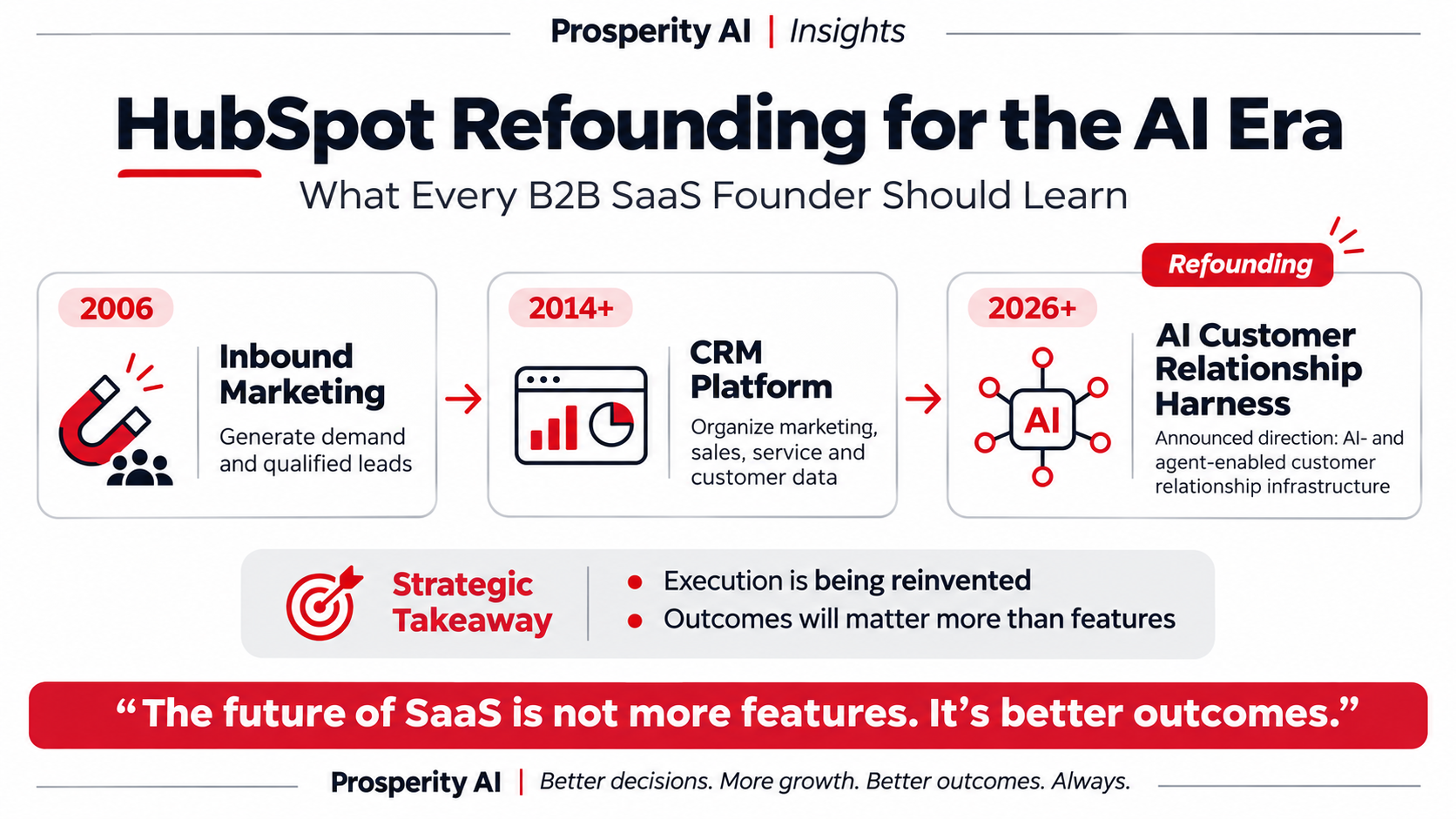
HubSpot Is Refounding for the AI Era: What Every B2B SaaS Founder Should Learn
Why one of the world’s most established SaaS companies is reinventing itself — and what this signals about the future of software, AI, and business growth.
By Pierluigi Merico | Founder & CEO, Prosperity AI Inc.
November 12, 2026 | B2B SaaS Evolution & AI Transformation
A Successful SaaS Company Is Starting Over
Twenty years after founding HubSpot, Brian Halligan and Dharmesh Shah are preparing to reinvent the company for the artificial intelligence era.
On November 12, 2026, HubSpot officially announced Halligan’s return as CEO, succeeding Yamini Rangan.
The announcement signals more than a leadership transition.
HubSpot is rethinking how its products create value, how customers interact with software, and how AI changes the economics of business execution.
The company describes this transformation as a refounding.
For B2B SaaS founders, the strategic significance is substantial.
If a company with more than 311,000 customers is reconsidering its operating model, every SaaS founder should be asking what AI will change about their own business.
1. Three Eras of B2B SaaS Value Creation
HubSpot’s evolution illustrates three important stages in the software industry’s development.
2006 — The Inbound Marketing Era
HubSpot helped companies attract customers through content, digital marketing, and automation.
Value created: Generating demand and qualified leads.
2014 Onward — The CRM Platform Era
HubSpot evolved into an integrated platform connecting marketing, sales, customer service, and customer data.
Value created: Organizing customer information and improving commercial operations.
2026 Onward — The AI Customer Relationship Era
HubSpot is now pursuing what it calls a Customer Relationship Harness, alongside a vision for headless, AI-enabled customer relationship software.
The direction points toward systems in which AI agents can support more customer-related work through flexible interfaces and workflows.
Potential value: Moving beyond software that organizes work toward software that helps execute it and improve outcomes.
This third stage represents HubSpot’s announced strategic direction, not an already demonstrated transformation.
2. Why Refound a Company That Is Still Growing?
HubSpot’s latest financial results make the decision particularly interesting.
Under Yamini Rangan’s leadership, the company expanded significantly.
* Customers grew from approximately 135,000 in 2021 to more than 311,000 by September 2026.
* Annual revenue increased from approximately $1.3 billion in 2021 toward an expected $3.7 billion in 2026.
* Third-quarter 2026 revenue reached approximately $948 million, up 17% year over year.
HubSpot is not announcing its refounding following an obvious collapse in commercial performance.
It is attempting to transform while continuing to grow.
This is an important strategic lesson: successful companies cannot assume that yesterday’s business model will remain optimal in an AI-native market.
The next competitive advantage may require changing the business before current performance forces that change.
3. AI Is Changing Where Software Creates Value
Traditional B2B SaaS helped customers manage activities.
CRM systems managed relationships.
Marketing platforms organized campaigns.
Sales tools supported pipeline execution.
Analytics software measured performance.
AI introduces the possibility of a different relationship between users and software.
Instead of simply providing tools, software can increasingly help perform tasks, coordinate workflows, and support decisions.
This creates a fundamental question for founders:
Will customers continue paying primarily for access to software features, or increasingly for the value and outcomes software helps produce?
The answer will vary across products and business models.
But the direction deserves attention.
Adding an AI assistant to an existing product may improve usability.
Reconsidering the entire customer workflow may create a more substantial opportunity.
4. Execution Intelligence vs. Decision Intelligence
HubSpot’s announced transformation also highlights a distinction central to Prosperity AI’s strategy.
Businesses need intelligence to support both execution and decisions.
HubSpot’s direction is centered on customer relationships, commercial workflows, and agentic execution.
Prosperity AI is developing an AI Growth Intelligence System focused on understanding business constraints and supporting strategic decision-making.
The distinction can be summarized through two questions.
Execution Intelligence
How can we execute commercial activities more efficiently?
Growth Decision Intelligence
What should we prioritize, why does it matter, and how will we measure success?
Consider a hypothetical B2B SaaS company generating $5 million in Annual Recurring Revenue but experiencing slower growth.
Its CRM and marketing systems may help improve campaigns, pipeline visibility, lead scoring, and customer engagement.
But management must first understand whether the primary constraint is:
* An overly broad Ideal Customer Profile.
* Weak trial-to-paid conversion.
* Poor economic-buyer alignment.
* High customer churn.
* Inefficient acquisition economics.
The right intervention depends on the diagnosis.
Executing the wrong strategy more efficiently does not necessarily produce better economic outcomes.
The two forms of intelligence can complement each other.
This is a strategic architecture concept, not a claim that Prosperity AI and HubSpot already have a live integration.
5. What This Means for Prosperity AI
HubSpot’s refounding reinforces three priorities relevant to our development of Prosperity AI.
First — Strengthen the Growth Decision Layer
Prosperity AI is designed to help founders identify their primary growth constraint, compare strategic alternatives, and prioritize the decision with the strongest potential economic impact.
Its role is not to replace an entire CRM or GTM execution platform.
It is to provide a structured growth intelligence framework that complements existing business systems.
Second — Move Toward Continuous Intelligence
A Business Review provides a strategic assessment at a particular moment.
But business conditions change.
Prosperity AI connects four levels of strategic support:
Free Discover — Identify potential growth constraints, strategic weaknesses, GTM Readiness, and the highest-ROI decision.
Business Snapshot — Understand the business through five core strategic dimensions.
Full Business Review + Executive Plan — Expand the analysis across 27 dimensions and prioritize a 90-day execution roadmap.
Monday Morning Executive Brief — Revisit changes, priorities, risks, and previous decisions.
The long-term objective is to connect strategic diagnosis with execution and measured outcomes.
Third — Connect Strategic Intelligence With Operational Evidence
A future opportunity is to connect growth intelligence with relevant CRM, financial, and analytics systems.
Such integrations could help validate strategic hypotheses against operational evidence.
For example, a recommended improvement in customer activation could eventually be compared with actual conversion, retention, and financial results.
This remains a development opportunity requiring technical integration, reliable data access, and outcome validation.
It should not be confused with an integration already available.
6. Three Questions Every B2B SaaS Founder Should Ask
HubSpot’s announcement offers a useful opportunity for founders to reconsider their own strategies.
1. What would we build differently if we started our company today?
Would the product still have the same interface, features, pricing model, and workflows?
Or could AI fundamentally change how customers obtain value?
2. Where does our product create measurable economic value?
Which customer problems are urgent enough to justify spending?
What outcomes matter to the economic buyer?
Which capabilities are differentiated rather than simply expected?
3. What is our most important growth constraint today?
Should we improve the product, narrow our ICP, strengthen retention, change pricing, or accelerate distribution?
The answer should come from business context and evidence, not from the popularity of the latest AI technology.
7. The Next Generation of SaaS Will Compete on Outcomes
The history of SaaS demonstrates how software companies have repeatedly expanded their value propositions.
From digitizing processes to connecting workflows.
From enabling teams to work more efficiently to increasingly supporting the execution of work itself.
AI may accelerate this evolution.
But for founders, technological capability is only part of the challenge.
The larger question is whether the company can translate new capabilities into customer value, differentiated positioning, repeatable commercial growth, and measurable economic results.
The next generation of SaaS won’t be defined simply by more features. It will increasingly be defined by better outcomes.
HubSpot’s refounding is an important signal of this transition.
And it reinforces the principle behind Prosperity AI:
AI is making execution cheaper. That makes deciding what to execute more valuable.
The Strategic Question for Every Founder
If HubSpot is willing to rethink its business model after two decades of growth, what should every B2B SaaS founder be reconsidering today?
The answer may not require rebuilding the entire company.
It may begin with identifying the constraint that matters most.
Understand the busines
Methodology: This insight applies Prosperity AI’s Growth Intelligence framework to the evidence and context available for the review. Conclusions should be read with the linked evidence and validated against current business data.