Prosperity AI · Insight
GTM Readiness: How to Know If Your Business Is Ready to Scale
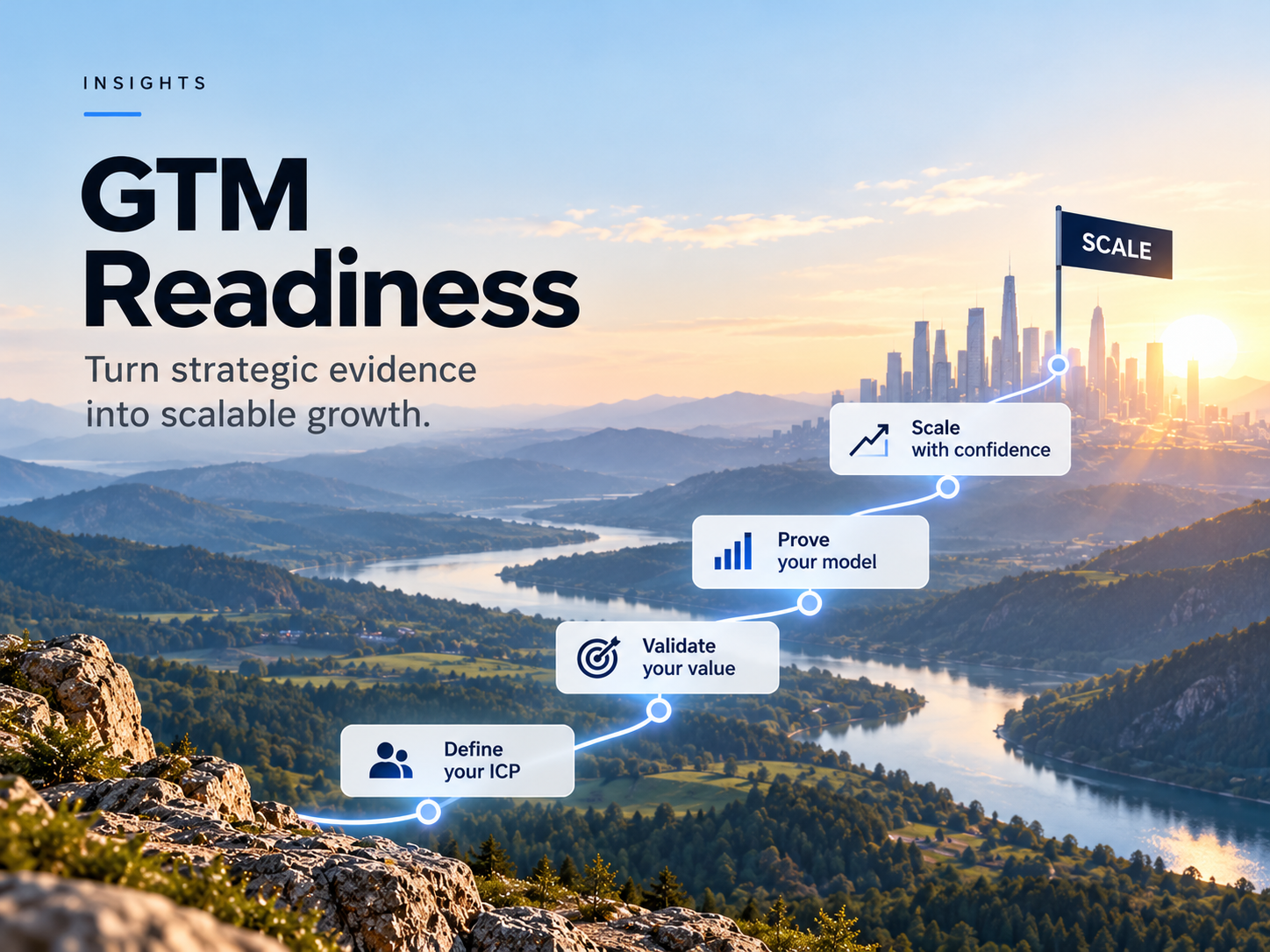
GTM Readiness: How to Know If Your Business Is Ready to Scale
Why successful growth starts with evidence, not execution.
October 17, 2026 | Growth Intelligence Insights
The Growth Question Most Companies Ask Too Late
Most companies ask: “How can we grow faster?”
But there is a more important question:
Are we actually ready to scale?
Increasing marketing budgets, hiring salespeople, expanding into new markets, or launching additional products can accelerate growth.
They can also accelerate the cost of a strategy that has not yet been validated.
This is why GTM Readiness (Go-to-Market Readiness) matters.
Before deciding how much to invest in growth, leadership teams need to understand whether their customer targeting, value proposition, pricing, distribution and revenue model are supported by sufficient evidence.
At Prosperity AI, we approach GTM Readiness as a strategic decision problem.
The objective is not simply to grow faster. It is to identify when, where and how growth investment can generate the strongest economic outcome.
1. What Is GTM Readiness?
GTM Readiness measures how prepared a business is to acquire, convert and retain customers through a coherent, evidence-supported go-to-market strategy.
It goes beyond product readiness.
A company may have an excellent product, advanced technology and a large addressable market while still lacking the commercial evidence required to scale predictably.
A meaningful GTM Readiness assessment examines whether the business can answer five essential questions:
1. Who is the ideal customer? Is the Ideal Customer Profile specific and supported by evidence?
2. Why does that customer buy? Is there a sufficiently important and urgent problem?
3. Why choose this solution? Is the value proposition differentiated and credible?
4. How does the business acquire customers? Is there a repeatable distribution and sales motion?
5. Can growth produce sustainable economics? Are pricing, acquisition costs, retention and customer value aligned?
GTM Readiness is not a certification or a guarantee of future growth.
It is an assessment of the evidence supporting the company’s next commercial decisions.
2. Product-Market Fit Is Not the Same as GTM Readiness
Product-Market Fit suggests that a product delivers meaningful value to a market.
GTM Readiness evaluates whether the business is prepared to turn that value into repeatable commercial results.
The distinction is critical.
Consider an AI company with strong technical capabilities, positive product feedback and several paying customers.
Those are encouraging signals.
But important questions remain:
* Do the customers share a clearly identifiable profile?
* Are they buying for the same underlying reason?
* Can new customers discover and understand the product consistently?
* Does the pricing model reflect the economic value delivered?
* Can the company reproduce customer acquisition without relying exclusively on its founders?
If the answers are unclear, increasing execution capacity may not solve the constraint.
Product value creates opportunity. GTM Readiness determines whether that opportunity can be pursued through a repeatable commercial system.
3. The Eight Dimensions of GTM Readiness
At Prosperity AI, GTM Readiness is evaluated through an evidence-oriented framework.
Eight dimensions help leadership teams distinguish between strategic assumptions and validated commercial signals.
Dimension 1 — Ideal Customer Profile Clarity
Does the company know which customers are most likely to experience meaningful value and become commercially attractive accounts?
A broad addressable market is not the same as a validated ICP.
The strongest evidence comes from actual customer behavior, purchasing patterns, conversion data and retention.
Dimension 2 — Problem Urgency
Is the problem important enough for customers to take action now?
A product can solve a genuine problem without solving a sufficiently urgent purchasing priority.
Urgency influences sales cycles, conversion and willingness to invest.
Dimension 3 — Value Proposition and Differentiation
Can customers understand what changes when they adopt the solution?
Effective positioning communicates a clear economic or operational outcome, not merely a collection of product capabilities.
Differentiation must be meaningful to the buyer.
Dimension 4 — Willingness to Pay
Have customers demonstrated that they will pay for the outcome?
Interest, traffic and engagement are not substitutes for commercial validation.
Evidence may include paid pilots, completed purchases, renewals or credible buying commitments.
Dimension 5 — Pricing and Sales Motion
Does the pricing structure match customer value, buying behavior and the cost of serving the account?
The appropriate go-to-market motion may be product-led, sales-led, partner-led or hybrid.
What matters is that the chosen motion is consistent with the customer segment and supported by evidence.
Dimension 6 — Channel Fit
Can the company reach qualified buyers through channels that demonstrate repeatable performance?
Marketing visibility alone is insufficient.
Leadership teams need to understand which channels generate qualified demand, conversions and economically attractive customers.
Dimension 7 — Activation, Retention and Expansion
Do customers consistently reach value after purchasing or signing up?
Initial acquisition is only part of the growth equation.
Activation, continued usage, retention and expansion reveal whether the business can sustain the value it promises.
Dimension 8 — Traction Concentration and Repeatability
Is growth emerging from a repeatable customer pattern or from isolated successes?
Ten customers from the same well-defined segment, purchasing for similar reasons, can sometimes provide more actionable strategic evidence than a larger but highly fragmented customer base.
The question is whether successful outcomes can be repeated.
4. From Hypothesis to Evidence to Validation
A central principle of the Prosperity AI approach is that not all business assumptions carry the same level of confidence.
GTM Readiness should distinguish three stages:
HYPOTHESIS
The business believes a strategic assumption is true, but supporting evidence remains limited.
Example: “Mid-market SaaS companies are our ideal customers.”
EVIDENCE
Observable signals support the assumption, although consistency and repeatability have not yet been established.
Example: “Several mid-market SaaS companies have adopted our product and demonstrated meaningful usage.”
VALIDATED
Repeated customer behavior and measurable outcomes provide stronger support for the assumption within a defined market context.
Example: “A consistent group of mid-market SaaS customers has converted, reached value and renewed through a repeatable acquisition motion.”
Validation is not permanent.
Markets, customer behavior and competitive conditions change. A validated assumption may need to be tested again as the company expands.
The strategic value of GTM Readiness comes from understanding what has been demonstrated, what remains uncertain and which decision should be tested next.
5. Why Scaling Before GTM Readiness Can Destroy Value
Many growth problems begin with premature execution.
Consider a B2B SaaS company experiencing inconsistent conversion.
Management decides to double its marketing budget.
Traffic increases.
Lead volume improves.
But revenue does not grow proportionally.
The team responds by investing in sales automation, additional campaigns and more sales resources.
The actual constraint, however, may be an unclear ICP or a value proposition that does not communicate sufficient business impact.
Execution has become more expensive without solving the underlying problem.
A GTM Readiness assessment encourages a different sequence:
Diagnose → Validate → Decide → Execute → Measure
This sequence does not eliminate risk.
It helps leadership teams distinguish investments that address the underlying growth constraint from investments that merely increase activity.
6. AI Changes the Economics of GTM Decisions
Artificial intelligence is transforming the economics of business execution.
Content production, market research, campaign development, data analysis and sales workflows can increasingly be supported by AI systems.
This creates a new strategic challenge.
When execution becomes cheaper and faster, companies can launch more initiatives with less friction.
But a greater capacity to execute does not necessarily improve the quality of strategic decisions.
In fact, it may amplify the consequences of poor prioritization.
AI is making execution cheaper. That makes deciding what to execute more valuable.
The competitive advantage increasingly depends on a company’s ability to identify the most important constraint, choose the highest-value intervention and measure the resulting outcome.
That is where AI Growth Intelligence becomes relevant.
7. How Prosperity AI Evaluates GTM Readiness
Prosperity AI is building an AI Growth Intelligence System designed to connect business diagnosis, decision-making, execution planning and continuous measurement.
GTM Readiness forms part of this process.
The system helps identify:
* The business’s primary growth constraint.
* Strategic weaknesses that may reduce commercial performance.
* GTM assumptions that need stronger validation.
* The highest-ROI decision to prioritize.
* The actions required to improve growth readiness.
The objective is not to produce another static strategy document.
It is to help leadership teams iden
Methodology: This insight applies Prosperity AI’s Growth Intelligence framework to the evidence and context available for the review. Conclusions should be read with the linked evidence and validated against current business data.