Prosperity AI · Insight
AI Makes Execution Faster. Growth Intelligence Makes Growth Smarter.
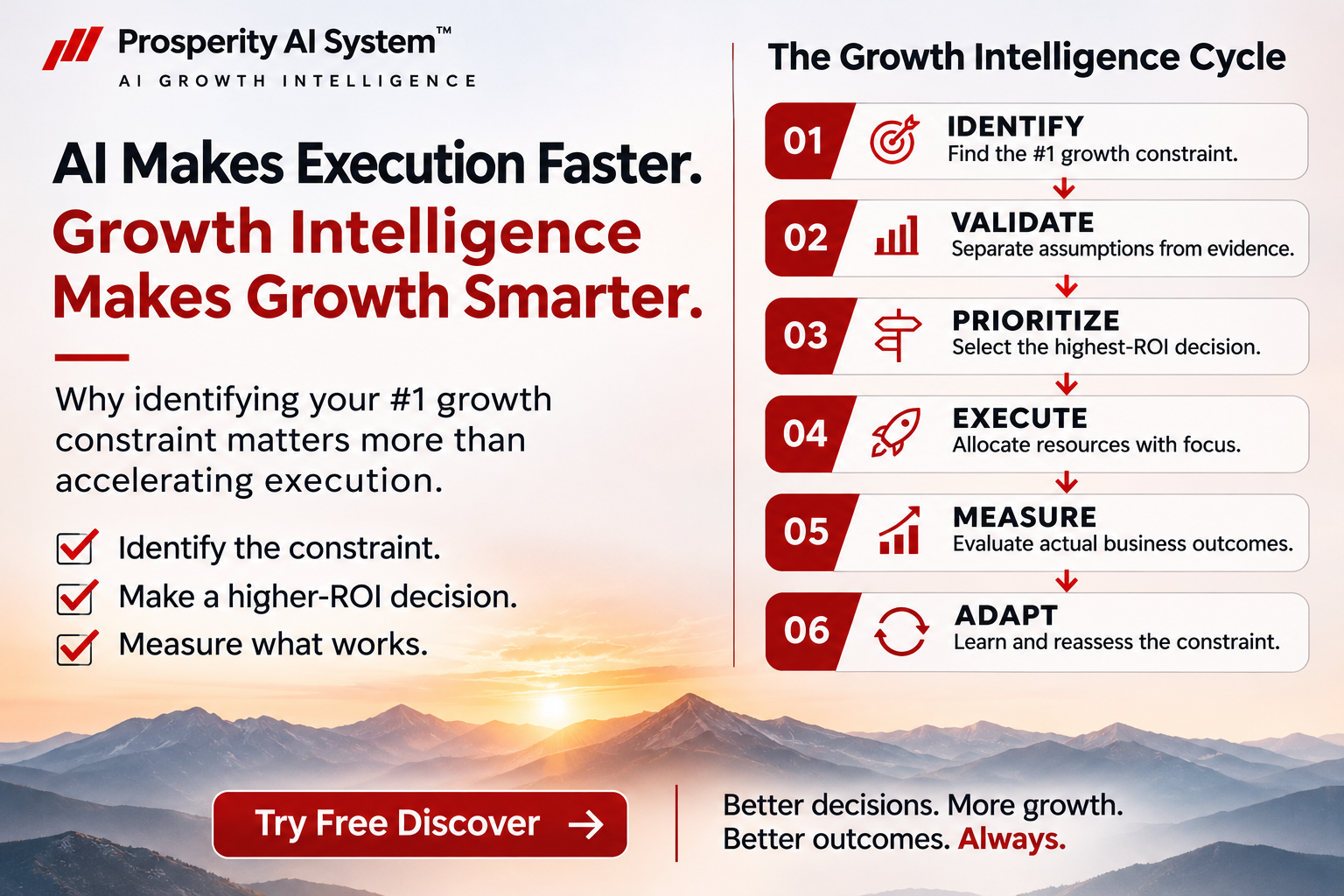
AI Makes Execution Faster. Growth Intelligence Makes Growth Smarter.
Why identifying your #1 growth constraint matters more than accelerating execution.
Prosperity AI Insights | Strategy & Growth Intelligence
Artificial intelligence is fundamentally changing the economics of execution.
Founders can now build products faster, generate more content, automate workflows, launch campaigns, and scale operations with fewer resources.
But a fundamental business problem remains:
Faster execution does not necessarily translate into faster growth.
In fact, accelerating the wrong activities can amplify existing business weaknesses.
01 - The Execution Trap
Consider three B2B SaaS companies:
* A company doubles its acquisition budget while customer retention remains weak.
* A company accelerates product development before validating its Ideal Customer Profile (ICP).
* A company expands its sales team before establishing a repeatable go-to-market motion.
All three companies are executing.
None is necessarily solving its most consequential growth problem.
The risk is not a lack of execution.
It is the misallocation of execution.
As AI reduces the cost of doing things, deciding what deserves to be done becomes increasingly valuable.
02 - Every Business Has Growth Constraints
Growth is rarely limited by a single isolated activity.
It is influenced by the interaction of multiple strategic dimensions:
* Market demand
* ICP validation
* Value proposition
* Customer acquisition
* Product activation
* Customer retention
* Pricing and monetization
* Unit economics
* Go-to-market readiness
* Operational scalability
At any given stage, one constraint may have a disproportionate impact on business performance.
Identifying that constraint is one of the most important responsibilities of a founder or CEO.
But identifying a potential constraint is not the same as validating it.
03 - How Do You Know Retention Is the Real Constraint?
Imagine a B2B SaaS company considering an increase in its customer acquisition budget.
Before recommending additional acquisition, several questions deserve attention:
* Are existing customers achieving their expected outcomes?
* Are customers returning and continuing to use the product?
* Is churn concentrated within a specific customer segment?
* Is Net Revenue Retention improving or deteriorating?
* Are customer acquisition costs recovered within a sustainable period?
If the available evidence suggests that new customers are replacing departing customers rather than generating sustainable growth, retention becomes a potential strategic constraint.
Consider this simplified example:
Monthly performance Company A Company B
Existing customers 1,000 1,000
New customers 100 100
Customers lost 80 20
Net customer growth 20 80
Both companies acquire the same number of customers.
Company B generates four times the net customer growth.
The appropriate decision for Company A may not be to acquire more customers.
It may be to understand why customers leave.
However, retention should not automatically be classified as the primary constraint. The economic impact of alternative decisions must also be evaluated.
04 - From Hypothesized to Validated Constraints
This distinction is fundamental to the Prosperity AI methodology.
Hypothesized Constraint
A potential growth bottleneck identified through available business information, market signals and strategic assessment.
Validated Constraint
A growth bottleneck supported by sufficient business evidence, internal performance data and measurable economic impact.
Publicly available information can support strategic hypotheses.
Internal customer, product and financial data can strengthen, invalidate or change those conclusions.
The process should follow a disciplined progression:
Assumption → Evidence → Validated Signal → Strategic Decision → Measured Outcome
AI should help founders reduce uncertainty, not disguise it.
05 - The Highest-ROI Decision
Once a growth constraint has been identified, the next question is not simply:
What should we do?
It is:
Which decision is most likely to generate the greatest measurable business impact relative to the resources required?
A founder might compare:
* Increasing customer acquisition.
* Improving onboarding and activation.
* Reducing customer churn.
* Narrowing the ICP.
* Restructuring pricing.
Each decision carries different expected outcomes, costs, risks, time requirements and levels of uncertainty.
Growth Intelligence is about evaluating these alternatives before committing resources.
The objective is not to generate more recommendations.
It is to improve the quality of strategic decisions.
06 - Growth Intelligence Is a Continuous Decision System
Businesses evolve.
Markets change.
Customer behavior changes.
A constraint identified today may no longer be the primary constraint in three months.
This is why Growth Intelligence should operate as a continuous cycle:
1. Observe business performance.
2. Identify the #1 potential growth constraint.
3. Validate it through evidence.
4. Prioritize the highest-ROI decision.
5. Execute with clear objectives.
6. Measure actual outcomes.
7. Learn, adapt and reassess.
The effectiveness of a strategic decision should ultimately be evaluated against its observed outcome, not the persuasiveness of its initial recommendation.
07 - The Next Competitive Advantage
The first wave of enterprise AI adoption has largely focused on productivity and execution.
We believe the next strategic opportunity lies in improving the decisions that guide execution.
More content is not necessarily more demand.
More features are not necessarily more customer value.
More acquisition is not necessarily more sustainable revenue.
More AI is not necessarily more growth.
The competitive advantage is increasingly about knowing what matters most, why it matters, and how to measure its impact.
That is why we are building Prosperity AI - an AI Growth Intelligence System designed to help founders and CEOs identify growth constraints, prioritize higher-ROI decisions and measure actual outcomes.
Not a chatbot.
A decision system.
Discover Your #1 Growth Constraint
Start with Prosperity AI Free Discover.
* Identify your potential #1 growth constraint.
* Discover your three main strategic weaknesses.
* Assess your GTM Readiness.
* Identify your highest-ROI strategic decision to evaluate.
Try Free Discover:
https://prosperityaidemo.netlify.app/
⸻
AI makes execution faster.
Growth Intelligence helps founders decide what deserves execution.
Prosperity AI System
Better decisions. More growth. Better outcomes. Always.
www.prosperityai.ai
Methodology: This insight applies Prosperity AI’s Growth Intelligence framework to the evidence and context available for the review. Conclusions should be read with the linked evidence and validated against current business data.