Prosperity AI · Insight
How to Measure Whether a Business Decision Actually Worked
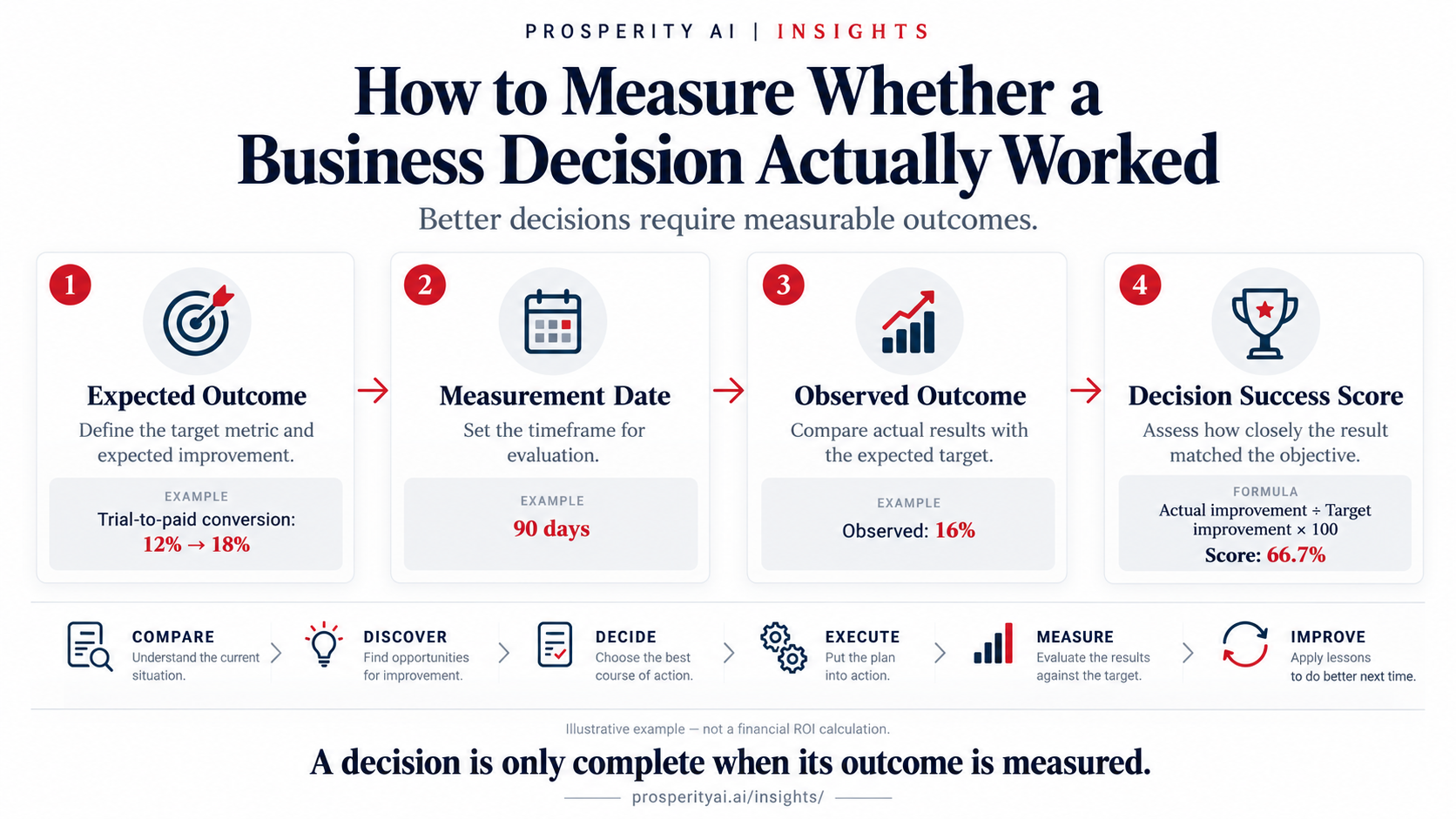
How to Measure Whether a Business Decision Actually Worked
Why the real value of strategic intelligence comes from connecting decisions to measurable economic outcomes.
By Prosperity AI Research Team
October 26, 2026
A Good Decision Is Not Enough. You Need to Know Whether It Worked.
Businesses make strategic decisions every day.
Increase marketing investment. Adjust pricing. Narrow the Ideal Customer Profile. Improve customer activation. Expand the sales team.
But how often do leadership teams return to those decisions and measure whether they generated the expected results?
A decision may appear strategically sound when it is made.
Its actual value becomes clearer only after execution and measurement.
A strategic decision is not complete when it is made. It is complete when its outcome is measured.
This is one of the fundamental principles behind AI Growth Intelligence.
1. From Strategic Decisions to Measurable Outcomes
Traditional strategic planning often follows a familiar sequence:
Analyze the business. Identify opportunities. Define priorities. Execute initiatives.
But one critical element is frequently missing: a structured comparison between expected and observed outcomes.
Without this feedback loop, companies risk repeating ineffective decisions or attributing success to initiatives that did not actually produce the improvement.
At Prosperity AI, our approach connects strategic analysis to four essential measurement elements:
Expected Outcome → Measurement Date → Observed Outcome → Decision Success Score
Together, these elements provide a framework for evaluating decision effectiveness.
2. The Four Elements of Decision Measurement
Expected Outcome
Every strategic decision should begin with a clearly defined, measurable objective.
For example:
A B2B SaaS company decides to improve its onboarding experience.
Expected Outcome: Increase trial-to-paid conversion from 12% to 18%.
The expected result should specify the metric, its baseline, the target, and the assumptions behind the intervention.
Measurement Date
Every decision requires an appropriate evaluation period.
Some initiatives produce measurable signals within weeks. Others, such as customer retention improvements or enterprise sales initiatives, may require several months.
A defined Measurement Date creates accountability and prevents decisions from remaining indefinitely unverified.
Observed Outcome
Once the measurement period ends, the company compares actual performance with the original expectation.
Continuing the example:
Expected conversion rate: 18%.
Observed conversion rate: 16%.
The intervention generated an improvement, but did not fully achieve its target.
That distinction matters.
It provides evidence for deciding whether to continue, modify, or discontinue the initiative.
Decision Success Score
A Decision Success Score can summarize how closely an observed result matches the expected outcome.
For example, an illustrative scoring approach can compare actual improvement against the targeted improvement.
However, a meaningful assessment must consider more than a single KPI.
Costs, risks, execution quality, external factors, and the reliability of the evidence also matter.
The purpose of a Decision Success Score is not to declare every decision a success or failure. It is to make outcomes comparable and improve future decisions.
3. A Practical Example: Improving SaaS Conversion
Consider a hypothetical B2B SaaS company evaluating an onboarding improvement.
Measurement Result
Strategic decision Improve product onboarding
Primary metric Trial-to-paid conversion
Baseline 12%
Expected Outcome 18%
Measurement Date 90 days
Observed Outcome 16%
Actual improvement +4 percentage points
Target improvement +6 percentage points
Using a simple illustrative calculation:
Decision Success Score = Actual Improvement ÷ Target Improvement × 100
Score = 4 ÷ 6 × 100 = 66.7%
Under this simplified model, the company achieved approximately 67% of the intended improvement.
This does not mean the decision generated a 67% financial ROI, nor does it prove that onboarding caused the entire improvement.
A reliable evaluation should also examine acquisition mix, customer cohorts, implementation costs, and whether the improvement persists.
The value of the exercise is that management can now make its next decision using observed evidence rather than assumptions alone.
4. Why Decision Measurement Creates Economic Value
The ultimate objective of business strategy is not simply to improve operational metrics.
It is to generate sustainable economic value.
Different decisions affect different areas of performance:
* Acquisition improvements may reduce Customer Acquisition Cost (CAC).
* Pricing changes may improve average revenue or contribution margin.
* Better onboarding may increase activation and paid conversion.
* Retention initiatives may improve customer lifetime value.
* Operational changes may reduce costs and increase efficiency.
But measuring an operational improvement is only the first step.
Leadership teams must also determine whether the economic benefit justifies the resources invested.
A decision can improve a metric without creating a positive economic return.
This is why Decision Intelligence should connect performance indicators to costs, risks, and financial outcomes wherever reliable data is available.
5. From Isolated Decisions to Continuous Growth Intelligence
The next opportunity for AI is not simply generating more recommendations.
It is building systems that help organizations learn from the results of previous decisions.
Prosperity AI’s strategic framework follows a continuous cycle:
COMPARE → DISCOVER → DECIDE → EXECUTE → MEASURE → IMPROVE
Each stage contributes to a stronger decision process.
Compare: Evaluate strategic alternatives.
Discover: Identify the primary growth constraint.
Decide: Prioritize the highest-ROI opportunity.
Execute: Translate the decision into a structured action plan.
Measure: Compare expected and observed outcomes.
Improve: Use the evidence to refine future decisions.
Over time, systematically validated outcomes can support better comparisons between business contexts, strategic interventions, and economic results.
This is the foundation of a developing Decision & Outcome Intelligence approach.
6. Why This Matters for Founders and CEOs
AI is making execution faster and more affordable.
Companies can launch more campaigns, build more features, and automate more processes with fewer resources.
But increased execution capacity does not automatically improve strategic effectiveness.
The competitive advantage increasingly depends on three capabilities:
Knowing which decision matters most.
Executing it with measurable objectives.
Learning whether it produced the expected economic outcome.
This turns strategic planning into a continuous learning process.
Instead of asking only, What should we do next?, leadership teams can also ask:
What did our previous decision teach us?
The Future of Growth Is Measurable Decision Intelligence
A business does not become more intelligent simply by collecting more data or generating more reports.
It becomes more intelligent when evidence improves the quality of its decisions.
And when the outcomes of those decisions improve the quality of the next ones.
Metrics reveal what happened.
Intelligence helps explain why.
Decision measurement reveals what we should learn.
At Prosperity AI, our ambition is to connect business diagnosis, decision prioritization, execution planning, and continuous improvement into one AI Growth Intelligence System.
Because better decisions should ultimately produce better outcomes.
And better outcomes should make the next decision more informed.
Discover Your Next Growth Decision
Before investing more resources in growth, identify the strategic constraint that matters most.
Start with Prosperity AI Free Discover to explore your growth constraint, GTM Readiness, and highest-ROI decision.
For deeper strategic planning, explore the Full Business Review + Executive Plan, covering 27 strategic dimensions and a prioritized 90-day roadmap.
Explore Prosperity AI
Better decisions. More growth. Better outcomes. Always.
⸻
Methodology & Transparency
The Decision Success Score example in this article is an illustrative measurement framework, not a verified Prosperity AI product scoring formula.
The evaluation of decision effectiveness requires reliable baseline data, appropriately selected metrics, consistent measurement periods, and consideration of external influences.
Observed improvements do not automatically prove causation. Financial ROI requires comparing attributable economic benefits with the total costs of the decision.
AI-generated strategic recommendations and outcome assessments should be validated by the relevant business decision-makers.
Methodology: This insight applies Prosperity AI’s Growth Intelligence framework to the evidence and context available for the review. Conclusions should be read with the linked evidence and validated against current business data.