Prosperity AI · Insight
The 50 Metrics That Turn Insight Into Better Decisions
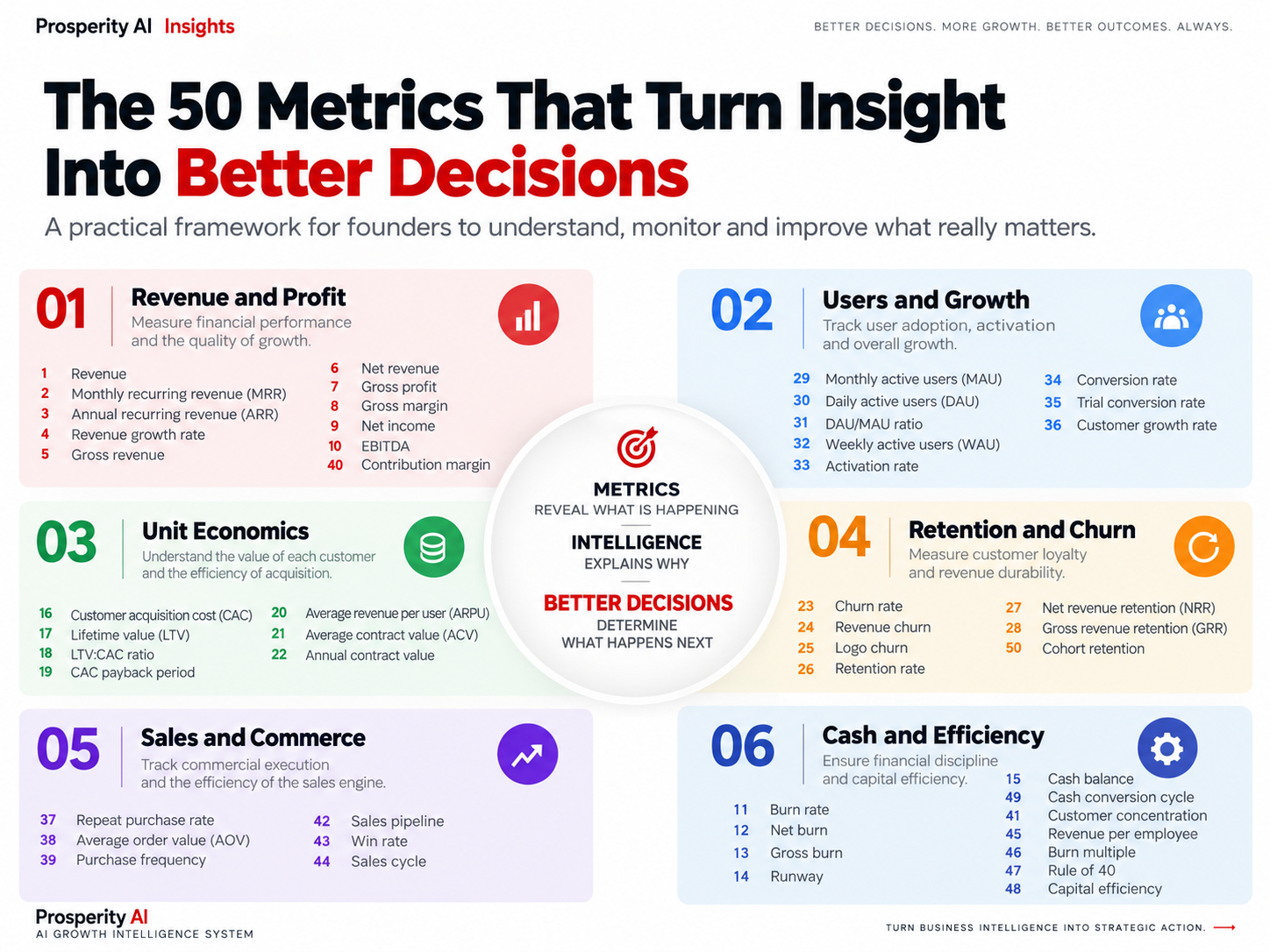
The 50 Metrics That Turn Insight Into Better Decisions
A practical framework for founders and CEOs to understand, monitor, and improve what really matters.
By Pierluigi Merico | Founder & CEO, Prosperity AI Inc.
October 21, 2026
Metrics Tell You What Is Happening. Intelligence Explains Why.
Every business generates data.
Revenue, customer acquisition costs, growth rates, retention, profitability, and cash flow all provide valuable signals.
But having access to more data does not automatically lead to better decisions.
The real competitive advantage comes from understanding which metrics matter, why they are changing, and what action should follow.
At Prosperity AI, we believe that business intelligence should not end with dashboards.
It should connect measurable performance to strategic decisions and economic outcomes.
This is why we developed a practical framework of 50 business metrics organized into six fundamental areas.
1. Revenue and Profit
Revenue growth alone does not reveal the quality of a business.
Companies need to understand whether growth is generating sustainable economic value.
Key metrics include:
* Revenue and revenue growth rate.
* Monthly Recurring Revenue (MRR).
* Annual Recurring Revenue (ARR).
* Gross profit and gross margin.
* Net income and EBITDA.
* Contribution margin.
The strategic question: Is the business growing profitably, or simply generating more revenue?
2. Users and Growth
Acquiring users is important. Understanding whether they activate, engage, and convert is essential.
Relevant metrics include:
* Monthly Active Users (MAU).
* Daily Active Users (DAU).
* Weekly Active Users (WAU).
* DAU/MAU ratio.
* Activation rate.
* Conversion and trial conversion rates.
* Customer growth rate.
The strategic question: Are we creating genuine customer adoption or simply increasing registrations?
3. Unit Economics
Unit economics reveal whether acquiring and serving customers creates sustainable value.
Important metrics include:
* Customer Acquisition Cost (CAC).
* Lifetime Value (LTV).
* LTV:CAC ratio.
* CAC payback period.
* Average Revenue Per User (ARPU).
* Average Contract Value (ACV).
* Annual Contract Value.
The strategic question: Does each additional customer strengthen or weaken the economics of our business?
4. Retention and Churn
Growth is difficult to sustain when customers leave as quickly as new customers arrive.
Retention metrics help measure the durability of customer relationships and recurring revenue.
Key metrics include:
* Customer churn rate.
* Revenue churn.
* Logo churn.
* Retention rate.
* Net Revenue Retention (NRR).
* Gross Revenue Retention (GRR).
* Cohort retention.
The strategic question: Are we building recurring customer value or constantly replacing lost revenue?
5. Sales and Commerce
A business needs more than demand.
It needs a measurable and repeatable commercial system.
Relevant metrics include:
* Sales pipeline.
* Win rate.
* Sales cycle.
* Average Order Value (AOV).
* Purchase frequency.
* Repeat purchase rate.
The strategic question: Can we consistently convert market demand into profitable customers?
6. Cash and Efficiency
Even high-growth businesses can encounter difficulties when growth consumes capital faster than expected.
Financial discipline is essential for sustainable expansion.
Important metrics include:
* Cash balance.
* Burn rate, gross burn, and net burn.
* Runway.
* Burn multiple.
* Cash conversion cycle.
* Revenue per employee.
* Rule of 40.
* Capital efficiency.
* Customer concentration.
The strategic question: Can our business finance its growth while maintaining financial resilience?
The Most Important Metric Is the One Connected to Your Current Growth Constraint
Monitoring 50 metrics does not mean that every metric deserves equal attention.
A company struggling with customer activation should not necessarily prioritize the same indicators as a company facing high churn or declining gross margins.
This is where AI Growth Intelligence becomes valuable.
The process begins by identifying the business’s primary growth constraint.
Then leadership teams can determine:
1. Which metrics reveal the problem.
2. What evidence explains its causes.
3. Which strategic decision could generate the greatest economic impact.
4. How success should be measured.
5. Whether the observed results justify continuing or changing direction.
The objective is not to optimize every metric. It is to improve the metrics that matter most for the next strategic decision.
From Metrics to Intelligence to Better Decisions
At Prosperity AI, our approach follows a continuous decision cycle:
UNDERSTAND → DIAGNOSE → DECIDE → EXECUTE → MEASURE → IMPROVE
Metrics reveal performance.
Intelligence connects performance to its possible causes.
Strategic decisions determine what the company should do next.
And outcome measurement provides the evidence required to improve future decisions.
A decision is only as valuable as what you learn from its outcome.
This is the foundation of a continuous Growth Intelligence System.
Better Decisions Start With Better Questions
The question is no longer simply:
What does our dashboard show?
The more valuable questions are:
What is limiting our growth?
Which decision would create the greatest economic value?
What evidence would demonstrate that the decision worked?
AI is making data analysis and execution faster.
But speed alone does not create competitive advantage.
The future belongs to businesses that consistently turn intelligence into better economic outcomes.
Discover What Matters Most for Your Business
Prosperity AI helps founders and CEOs identify their primary growth constraint, understand strategic weaknesses, assess GTM Readiness, and prioritize their highest-ROI decision.
Start with Free Discover.
Discover Your Growth Constraint
For deeper analysis, explore the Full Business Review + Executive Plan, covering 27 strategic dimensions and a prioritized 90-day execution roadmap.
Explore Prosperity AI
Better decisions. More growth. Better outcomes. Always.
Prosperity AI Inc. — AI Growth Intelligence System
⸻
Framework Note
The 50 metrics presented in the accompanying infographic form a practical reference framework, not a universal KPI checklist.
Metrics must be selected and interpreted according to the company’s business model, maturity, financial structure, and strategic priorities. Some metrics apply primarily to subscription businesses, while others are more relevant to transactional or enterprise sales models.
The framework supports strategic analysis and decision-making; it does not independently establish why business performance changes or guarantee specific outcomes.
Methodology: This insight applies Prosperity AI’s Growth Intelligence framework to the evidence and context available for the review. Conclusions should be read with the linked evidence and validated against current business data.