Prosperity AI · Insight
Don't Scale Uncertainty: Validate Before You Accelerate
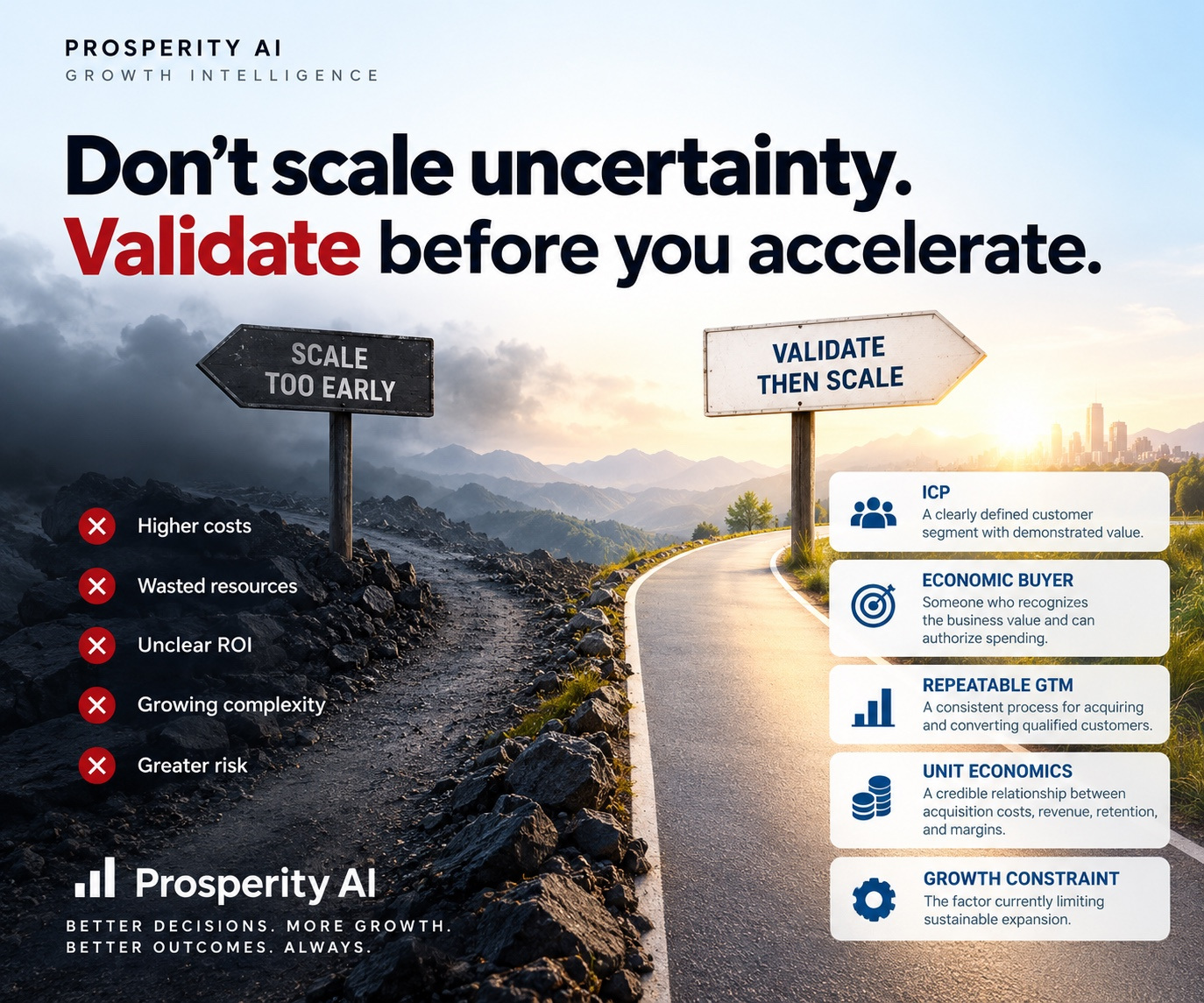
Don’t Scale Uncertainty: Validate Before You Accelerate
Why scaling before validating your business fundamentals can turn growth opportunities into expensive mistakes.
By Prosperity AI Research Team
October 29, 2026
Faster Growth Is Not Always Better Growth
Artificial intelligence is making execution faster, cheaper, and more accessible.
Companies can launch campaigns, develop products, automate sales processes, and expand operations with fewer resources than ever before.
But greater execution capacity creates a new strategic risk:
Scaling a business model that has not yet been sufficiently validated.
Many founders assume that the next stage of growth requires more marketing, more salespeople, more features, or faster expansion.
Sometimes that is the right decision.
But when fundamental business assumptions remain uncertain, increasing execution can amplify inefficiencies rather than improve economic outcomes.
Don’t scale uncertainty. Validate before you accelerate.
1. The Hidden Cost of Scaling Too Early
Premature scaling creates more than financial pressure.
It can introduce five interconnected problems:
Higher Costs
Acquisition, hiring, infrastructure, and operating expenses increase before the company has demonstrated that its commercial model can generate sustainable returns.
Wasted Resources
Capital and management attention are allocated to initiatives that may not address the underlying growth constraint.
Unclear ROI
Without reliable baseline metrics and validated customer economics, leadership teams struggle to determine whether additional investment creates real value.
Growing Complexity
More customers, channels, products, and processes increase organizational complexity before the business has established repeatable operations.
Greater Risk
Strategic uncertainty becomes more expensive as investment commitments increase.
The problem is not growth itself.
The problem is accelerating execution before understanding what makes growth repeatable.
2. The Five Areas Founders Should Validate
Before significantly increasing growth investment, leadership teams should examine five essential dimensions.
1. Ideal Customer Profile
Does the company know which customers experience the greatest value?
A broad target market is not the same as a validated Ideal Customer Profile.
Founders need evidence that a clearly defined customer segment consistently experiences an important problem, recognizes the solution’s value, and demonstrates commercial interest.
A focused ICP improves positioning, customer acquisition, and strategic learning.
2. Economic Buyer
Product users and economic buyers are not always the same people.
Technical teams may appreciate a solution, but the budget owner must understand its business impact.
Founders should identify who authorizes spending, which outcomes justify the investment, and how purchasing decisions are made.
Technical adoption creates opportunity. Economic-buyer alignment supports commercial conversion.
3. Repeatable Go-to-Market
Early customer acquisition does not automatically demonstrate a scalable GTM model.
A repeatable system requires sufficient evidence about:
* Qualified customer acquisition.
* Consistent conversion.
* Sales-cycle performance.
* Effective distribution channels.
* Customer activation and retention.
The critical question is whether the company can reproduce commercial results without relying entirely on exceptional circumstances or founder-led relationships.
4. Unit Economics
Growth should be evaluated against its economic consequences.
Relevant indicators include Customer Acquisition Cost (CAC), Lifetime Value (LTV), gross margin, retention, and CAC payback period.
A company may increase revenue while weakening its underlying financial performance.
More customers do not necessarily mean more economic value.
Before accelerating, founders should understand whether additional growth can support sustainable business economics.
5. The Primary Growth Constraint
Even when a company has several weaknesses, one constraint may currently have the greatest impact on performance.
It could be unclear positioning, weak customer activation, poor retention, insufficient willingness to pay, or an inefficient sales process.
Identifying that constraint changes how resources should be allocated.
Instead of increasing activity across the business, leadership teams can focus on the intervention most likely to remove the bottleneck.
3. What We Learned From 100 B2B SaaS Companies
In the Prosperity AI B2B SaaS Growth Intelligence Report 2026 — Second Edition, we examined 100 public strategic analyses of companies in the San Francisco Bay Area.
The research identified recurring patterns involving broad ICP definitions, economic-buyer misalignment, undifferentiated positioning, limited sales visibility, and insufficient GTM repeatability.
These findings reinforce a fundamental principle:
Growth is a sequencing problem before it becomes a scaling problem.
The companies were assessed using publicly available information, so the findings represent external strategic interpretations rather than verified internal performance.
Nevertheless, the recurring challenges illustrate why validation should precede major scaling commitments.
4. From Validation to Intelligent Growth
Scaling should not depend on intuition alone.
Founders need a structured process that connects strategic assumptions to observable evidence.
At Prosperity AI, we approach this through a continuous decision framework:
UNDERSTAND → DIAGNOSE → VALIDATE → DECIDE → EXECUTE → MEASURE
Understand: Establish the company’s business context.
Diagnose: Identify strategic weaknesses and the primary growth constraint.
Validate: Test critical assumptions using relevant customer and commercial evidence.
Decide: Prioritize the intervention with the strongest potential economic impact.
Execute: Translate the decision into a measurable action plan.
Measure: Evaluate whether the intervention produced the expected outcome.
This process does not eliminate uncertainty.
It helps leadership teams make better-informed decisions before committing additional resources.
5. How AI Growth Intelligence Supports Better Scaling Decisions
Artificial intelligence can accelerate business research, identify patterns, organize evidence, and support strategic comparisons.
But AI-generated analysis should not be confused with verified business performance.
At Prosperity AI, our AI Growth Intelligence System helps founders and CEOs identify potential growth constraints, strategic weaknesses, GTM Readiness, and highest-ROI decisions.
Through Free Discover, Business Snapshot, and Full Business Review + Executive Plan, businesses can move from initial diagnosis toward a prioritized growth strategy.
The objective is not simply to recommend more growth initiatives.
It is to identify which decision deserves attention now and what evidence should justify the next investment.
The Bottom Line: Validate First. Scale With Confidence.
Scaling is not the first step toward sustainable growth.
It is the result of building sufficient confidence in the business model, customer demand, commercial execution, and underlying economics.
Before accelerating, every founder should ask:
Do we know who our best customers are?
Do economic buyers recognize our value?
Can we acquire and retain customers repeatably?
Do our unit economics support expansion?
Have we identified the constraint that matters most?
When the answers are supported by reliable evidence, growth investments become more informed.
The goal is not to grow at any cost. It is to build a business capable of sustaining growth.
Discover Whether Your Business Is Ready to Scale
Before investing more in marketing, sales, or expansion, understand what may be limiting your growth.
Start with Prosperity AI Free Discover to identify your primary growth constraint, strategic weaknesses, GTM Readiness, and highest-ROI decision.
Start Free Discover
For deeper analysis, explore the Full Business Review + Executive Plan, covering 27 strategic dimensions and a prioritized 90-day execution roadmap.
Explore Prosperity AI
Better decisions. More growth. Better outcomes. Always.
⸻
Research & Methodology Note
This article draws on Prosperity AI’s strategic framework and the B2B SaaS Growth Intelligence Report 2026 — Second Edition, which synthesized 100 public company assessments.
The research is not statistically representative of the broader B2B SaaS market. Strategic observations based on public information require validation with internal customer, financial, and operational data.
GTM Readiness is an assessment of commercial preparedness, not a guarantee of successful scaling. The appropriate timing and scale of growth investment depend on company-specific evidence, constraints, and risk tolerance.
Methodology: This insight applies Prosperity AI’s Growth Intelligence framework to the evidence and context available for the review. Conclusions should be read with the linked evidence and validated against current business data.