Prosperity AI · Insight
What Will Remain Defensible When AI Becomes 10x or 100x More Capable?
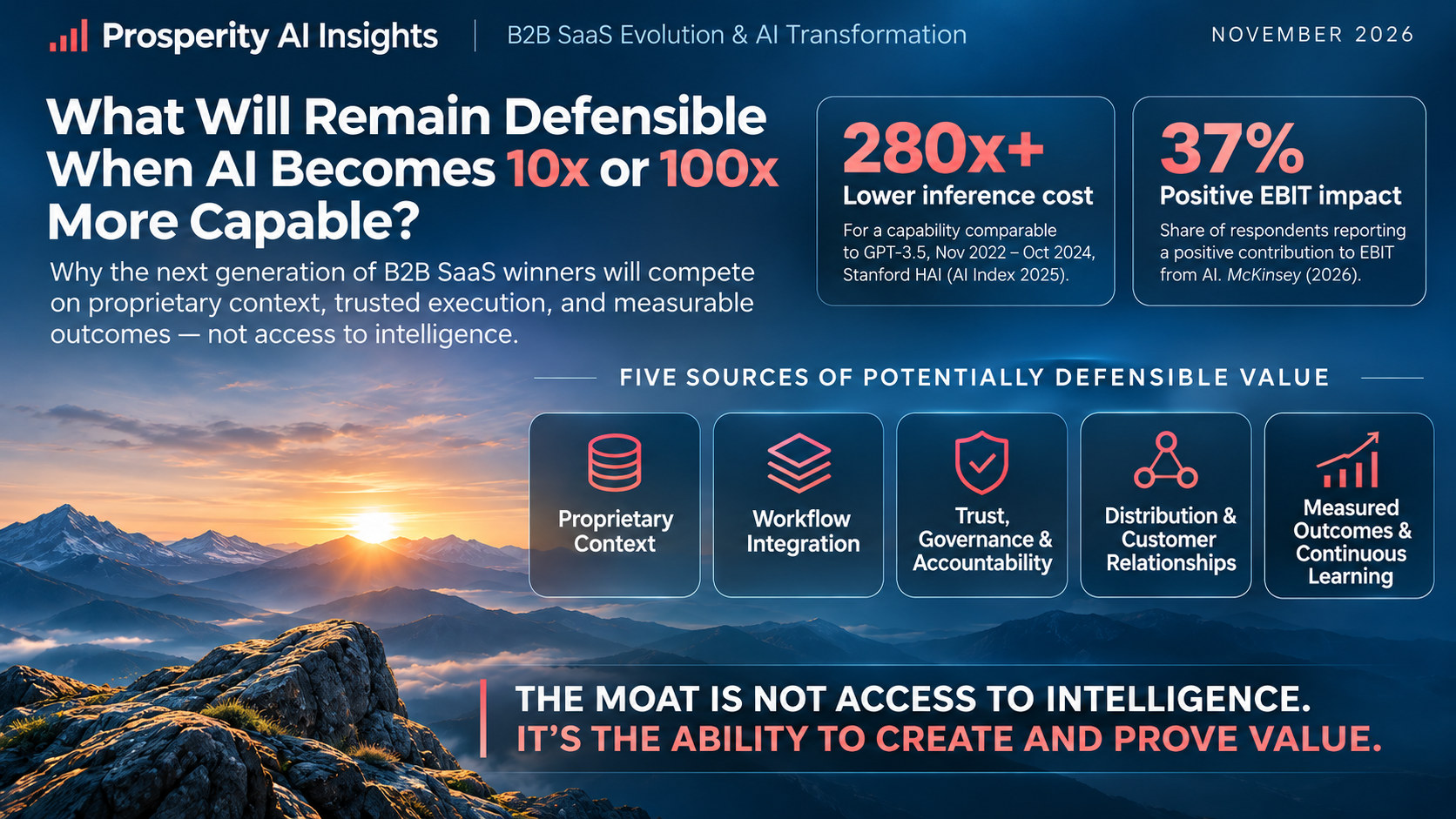
What Will Remain Defensible When AI Becomes 10x or 100x More Capable?
Why B2B SaaS winners will compete on proprietary context, trusted execution, and measurable outcomes, not simply access to intelligence.
By Pierluigi Merico | Founder & CEO, Prosperity AI Inc. | November 14, 2026
The Question Every SaaS Founder Should Ask Before 2027
What part of the value your company creates today will remain defensible when AI becomes 10 or 100 times more capable?
When competitors can access intelligence comparable to, or better than, what your product offers today, what will make customers continue choosing your company?
When intelligence becomes abundant, access to intelligence alone becomes a weaker competitive advantage.
The real question is: What does your company control, understand, or execute that more powerful AI cannot easily reproduce?
1. The Historical SaaS Advantage Is Changing
Salesforce, ServiceNow, and Workday created value beyond software functionality. They developed customer relationships, distribution, specialized knowledge, integrations, and embedded business processes.
AI is reducing certain technical barriers, making software capabilities easier and cheaper to reproduce. But replicating functionality is not the same as replicating a business.
Founders must distinguish replaceable features from genuinely defensible customer value.
2. Intelligence Is Becoming More Accessible
The Stanford AI Index 2025 documented a decline of more than 280 times in inference costs for AI systems performing at approximately GPT-3.5 level between November 2022 and October 2024.
McKinsey’s State of AI 2026 research also highlights the gap between productivity and economic impact:
* 80% reported individual productivity improvements.
* 37% reported a positive contribution to organizational EBIT.
* Approximately 6% qualified as AI high performers.
These figures refer to different measurements and populations within the research.
Better AI capabilities do not automatically produce better business economics. As intelligence becomes cheaper, companies must demonstrate differentiated and measurable value.
3. Five Sources of Defensible Value
01 — Proprietary Context
General-purpose AI may lack a company’s operational history, customer relationships, contractual constraints, and decision outcomes.
Proprietary context becomes valuable when it is difficult to reproduce, continuously updated, permissioned, and useful.
The advantage is turning unique business information into better decisions.
02 — Workflow Integration
AI features may be relatively easy to replace. Systems embedded in critical business processes can create stronger switching costs.
However, AI agents may also simplify integrations and software replacement. Defensibility depends on the actual difficulty and risk of changing the workflow.
03 — Trust, Governance, and Accountability
As AI assumes greater responsibility, enterprise customers need reliability, security, transparency, and accountability.
Trust becomes a competitive advantage when supported by verified performance and responsible governance.
04 — Distribution and Customer Relationships
Better technology does not automatically generate customer adoption. Companies still need effective positioning, access to economic buyers, customer relationships, and repeatable distribution.
The question is why customers will continue choosing your company when competing solutions improve.
05 — Measured Outcomes and Continuous Learning
Many AI products generate recommendations. Fewer demonstrate whether those recommendations improve business performance.
A valuable system connects decisions with expected and observed outcomes. Over time, validated evidence can help identify which interventions work in specific business contexts.
The potential moat is not the AI answer. It is the verified ability to improve decisions repeatedly.
4. The 10x and 100x AI Stress Test
Founders do not need to predict superintelligence to evaluate their business models.
Scenario A — AI becomes 10x more capable.
Competitors can reproduce much of your product’s analytical functionality with less effort.
Why would customers stay? Proprietary data, trusted relationships, workflow integration, or better outcomes?
Scenario B — AI becomes 100x more capable.
Advanced reasoning, software engineering, and autonomous execution become broadly accessible.
What economic role does your company still perform? Does it control critical business context, execute essential workflows reliably, or demonstrate superior economic outcomes?
If none of these advantages exists, the current value proposition may be exposed.
These scenarios are strategic stress tests, not technological forecasts.
5. The Next SaaS Constraint May Not Be Technology
A SaaS company may have excellent AI while struggling with unclear ICP, weak positioning, poor retention, insufficient buyer alignment, or inefficient acquisition.
The strategic question changes:
Which growth constraint prevents our existing capabilities from creating greater economic value?
This requires distinguishing:
Hypothesized Constraints: Potential limitations identified through public information or preliminary assessments.
Validated Constraints: Limitations confirmed through adequate internal data, customer evidence, and operational verification.
Confusing hypotheses with validated conclusions can lead to expensive strategic mistakes.
6. From AI Capability to Growth Intelligence
The next generation of business intelligence should connect evidence, strategic decisions, execution, and measurable outcomes.
PUBLIC EVIDENCE → ASSESSMENT → VALIDATION REQUIRED → HIGHEST-ROI DECISION → MEASURED OUTCOME
This is the approach behind the Prosperity AI Growth Intelligence System:
* Free Discover: Identifies potential growth constraints, three weaknesses, GTM Readiness, and the highest-ROI decision.
* Business Snapshot: Assesses five strategic business dimensions.
* Full Business Review + Executive Plan: Examines 27 dimensions and develops a prioritized 90-day roadmap.
* Monday Morning Executive Brief: Supports continuous strategic alignment and reviews of previous decisions.
The objective is not generating more reports. It is connecting business intelligence with better decisions and measurable results.
7. The Strategic Decision Every Founder Should Make
Identify the three main reasons customers pay for your product today.
Then ask whether those advantages would survive if competitors gained access to dramatically more capable AI.
Separate replaceable features from proprietary context, trusted execution, differentiated workflows, customer relationships, and verified outcomes.
Identify your most important vulnerability and validate it before investing additional resources.
The highest-ROI decision is the one that addresses the constraint most relevant to sustainable value creation.
Conclusion — The Value Is Not Intelligence Alone
AI will not eliminate software companies, but it will challenge the reasons customers pay them.
Products based mainly on increasingly commoditized intelligence may face substitution and pricing pressure.
Companies combining differentiated context, trusted execution, customer relationships, and verified outcomes may build stronger competitive advantages.
When intelligence becomes abundant, the advantage shifts toward understanding what matters, making better decisions, and proving they work.
That is the strategic challenge facing B2B SaaS founders heading into 2027 — and the future of Growth Intelligence we are building at Prosperity AI.
Discover Your Next Growth Decision
What is your company’s primary growth constraint? Which decision deserves priority?
START FREE DISCOVER
Explore Prosperity AI.
Better decisions. More growth. Better outcomes. Always.
Research & Methodology
This article combines published industry research and hypothetical AI scenarios, not technological forecasts. The five defensibility dimensions form an analytical framework, not statistically validated predictors.
Publicly inferred growth constraints remain hypotheses until verified with internal evidence. Outcome measurement must consider attribution, data quality, and external factors.
Sources: Stanford HAI — AI Index Report 2025; McKinsey — The State of AI in 2026 and AI Is Changing Work (2026); Deloitte — AI Disruption in Software Markets (2026).
Methodology: This insight applies Prosperity AI’s Growth Intelligence framework to the evidence and context available for the review. Conclusions should be read with the linked evidence and validated against current business data.