Prosperity AI · Insight
How Does Prosperity AI Measure Whether a Strategic Decision Worked?
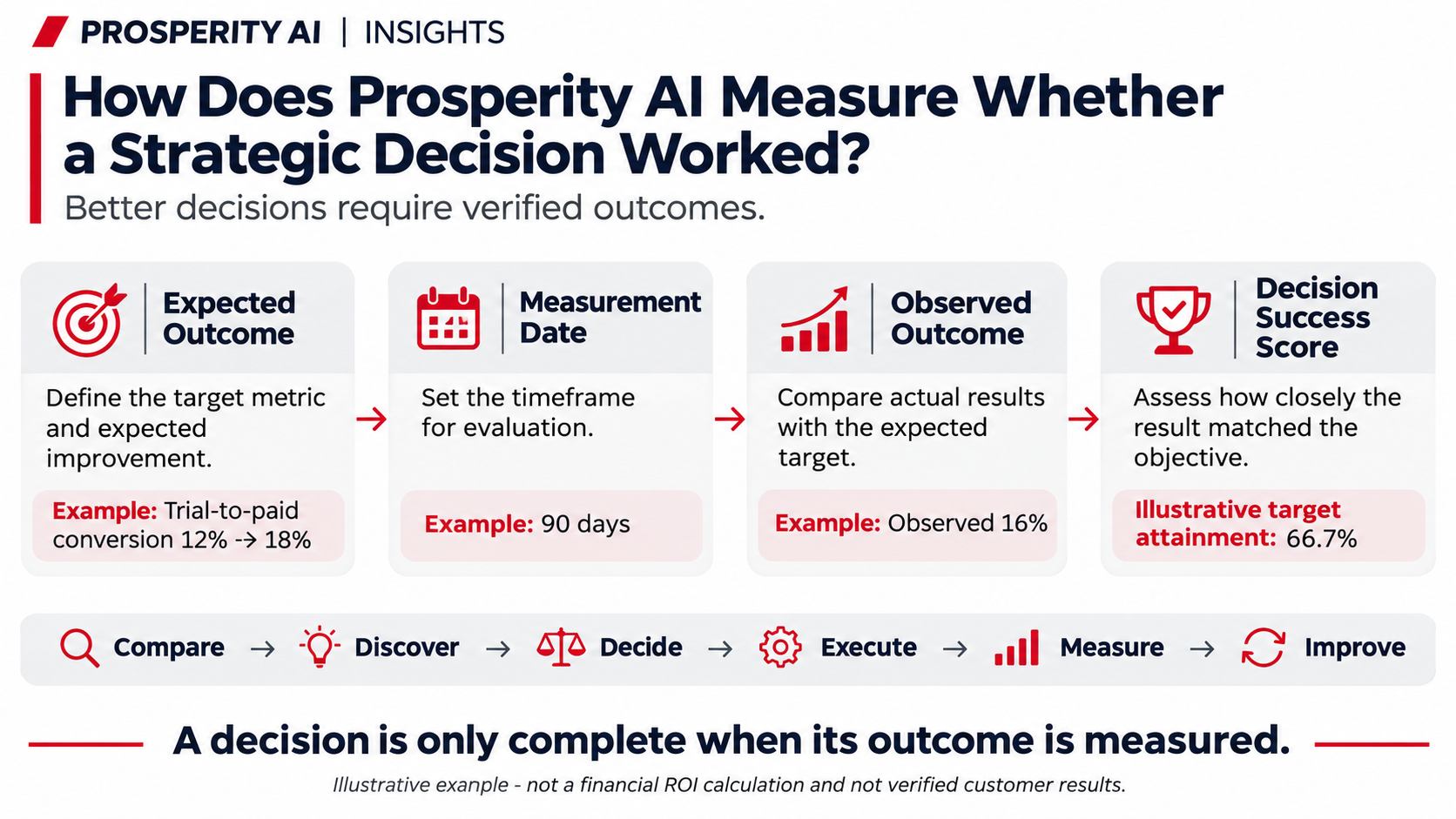
How Does Prosperity AI Measure Whether a Strategic Decision Worked?
From strategic recommendations to measurable outcomes: why decision quality depends on what happens after execution.
By Prosperity AI Research Team
November 7, 2026
A Strategic Decision Is Not Complete When It Is Made
Every business makes decisions.
Increase marketing spending. Narrow the Ideal Customer Profile. Improve customer activation. Adjust pricing. Expand sales capacity.
But one fundamental question is often overlooked:
Did the decision actually work?
A recommendation may appear strategically sound. An execution plan may be well structured. The expected return may look attractive.
None of these proves that the decision generated economic value.
At Prosperity AI, our approach to AI Growth Intelligence connects strategic diagnosis, decision prioritization, execution planning, and outcome measurement.
The objective is not simply to recommend better decisions. It is to create a structured process for learning from their results.
1. Start With the Growth Constraint
Measuring decision effectiveness begins before execution.
A company must first understand which problem it is trying to solve.
For example, a B2B SaaS company may report slower revenue growth.
The underlying constraint could be:
* An insufficiently validated ICP.
* Low trial-to-paid conversion.
* Weak economic-buyer alignment.
* High customer churn.
* Unsustainable customer acquisition costs.
Each constraint requires a different intervention and different success metrics.
If the problem is incorrectly diagnosed, measuring the wrong KPI may create misleading conclusions.
This is why Prosperity AI starts with business understanding and growth constraint identification.
2. The Four Elements of Decision Measurement
The Prosperity AI decision measurement framework connects four essential elements.
1. Expected Outcome
What measurable improvement should the decision produce?
The expected outcome defines the target before implementation.
For example:
A company decides to improve onboarding to increase trial-to-paid conversion from 12% to 18%.
The target is explicit and measurable.
2. Measurement Date
When should the outcome be evaluated?
Every decision requires an appropriate measurement period.
A marketing experiment may produce useful evidence within weeks.
Retention improvements or enterprise sales initiatives may require longer periods.
Defining the date creates accountability and establishes when the decision should be reviewed.
3. Observed Outcome
What actually happened?
After implementation, the company records the observed result and compares it with the original expectation.
Suppose trial-to-paid conversion increases from 12% to 16%.
The result demonstrates an improvement in the measured KPI, although the original target was not fully achieved.
The next question is whether that improvement can reasonably be attributed to the intervention.
4. Decision Success Score
How closely did the decision achieve its intended outcome?
A Decision Success Score provides a structured way to summarize performance against expectations.
For illustration, a simple target-attainment calculation can compare actual improvement with expected improvement.
In our hypothetical example:
* Baseline conversion: 12%.
* Expected conversion: 18%.
* Observed conversion: 16%.
* Target improvement: 6 percentage points.
* Actual improvement: 4 percentage points.
Illustrative target attainment: 4 ÷ 6 × 100 = 66.7%.
This means the observed improvement reached approximately 67% of the intended increase.
It is not a financial ROI calculation or a verified Prosperity AI product score.
A comprehensive decision assessment must also consider costs, risks, data quality, and external factors.
3. Measuring Improvement Is Not the Same as Measuring ROI
This distinction is essential.
A business decision can improve an operational metric without generating a positive economic return.
For example, improving conversion may produce more paying customers.
But the economic result depends on additional factors:
Incremental Revenue
How much additional revenue did the intervention generate?
Contribution Margin
How much of that revenue contributes to profitability after variable costs?
Implementation Cost
What resources were required to achieve the improvement?
Customer Quality
Did the new customers demonstrate sustainable retention and commercial value?
Attribution
How much of the observed improvement can reasonably be connected to the decision itself?
Only when these elements are adequately measured can management estimate the economic return of the intervention.
A successful KPI improvement is evidence of progress. A positive financial ROI requires additional economic validation.
4. From Individual Decisions to Continuous Learning
The longer-term value of decision measurement extends beyond a single intervention.
Consider a company that repeatedly records:
* Its business context.
* The primary growth constraint.
* The selected decision.
* The expected outcome.
* The measurement date.
* The observed result.
* The lessons learned.
Over time, this information can help leadership teams understand which interventions have worked in similar situations.
Prosperity AI’s continuous decision framework follows this sequence:
COMPARE → DISCOVER → DECIDE → EXECUTE → MEASURE → IMPROVE
Each completed measurement cycle can provide new evidence for future strategic decisions.
However, this learning depends on reliable data, consistent measurement, and validated outcomes.
Generating more recommendations alone does not establish which decisions work.
5. How This Connects to Prosperity AI
Prosperity AI is building an AI Growth Intelligence System designed to connect business analysis with measurable decision-making.
Its strategic workflow includes:
Free Discover
Identify the primary growth constraint, three strategic weaknesses, GTM Readiness, and a recommended highest-ROI decision.
Business Snapshot
Develop an initial understanding of the business across five strategic dimensions.
Full Business Review + Executive Plan
Expand the diagnosis across 27 strategic dimensions and translate strategic findings into a prioritized execution plan.
Monday Morning Executive Brief
Revisit business priorities, identify meaningful changes, and review progress against previous decisions.
Decision & Outcome Intelligence
Connect expected outcomes with observed results to support future decision-making.
These elements are designed to create continuity between analysis, strategy, execution, and measurement.
The objective is to support founders and CEOs in answering not only what should we do next? but also what did our previous decision teach us?
6. Why This Matters for B2B SaaS Founders
AI is making business execution faster and more affordable.
Companies can launch more campaigns, automate more processes, and test more initiatives.
But faster execution does not automatically improve economic performance.
The real strategic advantage increasingly depends on three capabilities:
Identify the right constraint.
Prioritize the decision with the strongest potential return.
Measure whether the intervention achieved its expected outcome.
This is especially important for B2B SaaS companies, where growth decisions influence acquisition costs, conversion, retention, recurring revenue, margins, and capital allocation.
Without outcome measurement, founders risk repeating ineffective strategies simply because they appeared logical when originally proposed.
The Future of AI Growth Intelligence Is Measurable
Traditional business analysis often ends with recommendations.
Prosperity AI’s vision extends beyond that point.
We aim to build a continuous intelligence system that connects business evidence, strategic decisions, implementation, and observed economic outcomes.
Over time, validated decision records could support more informed comparisons across business models, industries, and growth stages.
The long-term value is not the number of recommendations generated.
It is what we learn about which decisions produce better outcomes, for which businesses, and under which conditions.
Because a decision is only as valuable as what we learn from its result.
Discover Your Next Growth Decision
Start with Prosperity AI Free Discover to identify your primary growth constraint, GTM Readiness, and highest-ROI decision.
Start Free Discover
For deeper strategic analysis and execution planning, explore the Full Business Review + Executive Plan.
Explore Prosperity AI
Better decisions. More growth. Better outcomes. Always.
⸻
Methodology & Transparency
This article describes Prosperity AI’s decision measurement framework and its intended role in continuous business intelligence.
The numerical example is hypothetical. The 66.7% target-attainment calculation is illustrative and should not be interpreted as the official Decision Success Score formula or evidence of customer performance.
Observed improvements do not automatically establish causation or financial ROI.
Reliable outcome verification requires suitable baseline data, documented execution, consistent measurement, and consideration of external influences.
The level of automated outcome tracking available may depend on the implemented product capabilities and the quality of information provided by the business.
Methodology: This insight applies Prosperity AI’s Growth Intelligence framework to the evidence and context available for the review. Conclusions should be read with the linked evidence and validated against current business data.