Prosperity AI · Insight
ICP Validation: Why Targeting Everyone Slows B2B SaaS Growth
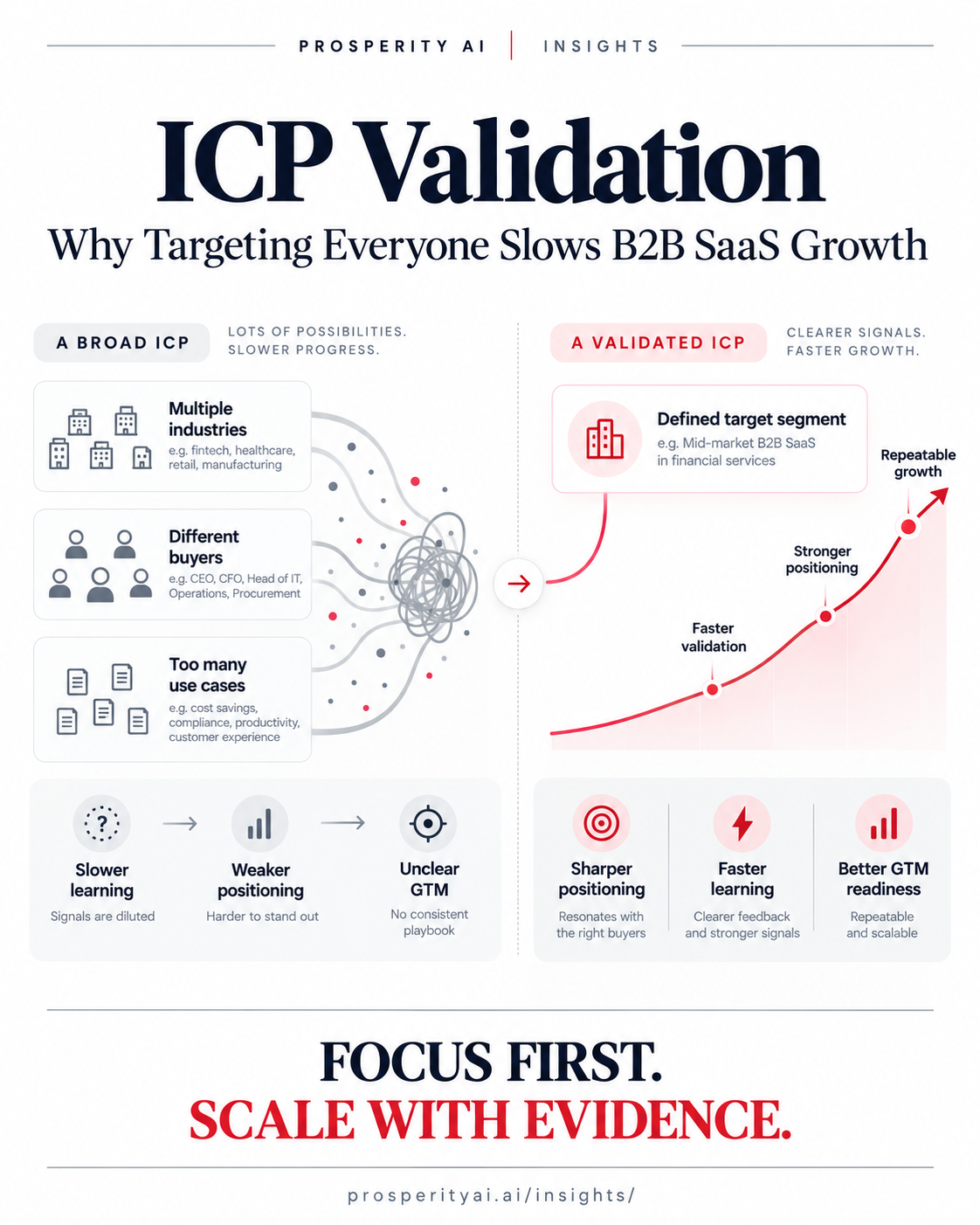
ICP Validation: Why Targeting Everyone Slows B2B SaaS Growth
What Prosperity AI learned from 100 B2B SaaS strategic analyses in the San Francisco Bay Area.
By Prosperity AI Research Team
October 20, 2026
A Bigger Market Doesn’t Always Mean Faster Growth
One of the most common strategic mistakes in B2B SaaS is assuming that a broader target market creates more growth opportunities.
In reality, targeting too many customers, industries, and use cases can make growth harder to achieve.
The reason is simple:
When everyone is a potential customer, it becomes difficult to understand which customers actually create repeatable economic value.
Across its first 100 public Business Reviews of B2B SaaS companies in the San Francisco Bay Area, Prosperity AI identified broad Ideal Customer Profiles (ICPs) as a recurring growth constraint.
The lesson is clear:
Focus is not about limiting opportunity. It is about accelerating validation.
1. What Is ICP Validation?
An Ideal Customer Profile describes the type of company most likely to benefit from a product and generate sustainable commercial value.
But defining an ICP is only the beginning.
ICP Validation means testing whether the target customer segment consistently demonstrates the behaviors that support a scalable business model.
These signals may include:
* A clearly identified and urgent business problem.
* Consistent product adoption and activation.
* Demonstrated willingness to pay.
* Repeatable customer acquisition.
* Sustainable retention and expansion potential.
* An identifiable economic buyer.
An ICP should be supported by customer evidence, not simply management assumptions.
2. What We Learned From 100 B2B SaaS Companies
The Second Edition of the Prosperity AI B2B SaaS Growth Intelligence Report 2026 highlights a recurring pattern:
Broad ICPs reduce learning speed.
Our analyses of Clidey/WhoDB, Poth Labs, and Assemble illustrate how broad customer targeting can complicate positioning, sales validation, and channel economics.
When companies simultaneously pursue multiple industries, buyer types, and use cases, they may struggle to identify which part of their commercial strategy is actually working.
Other reviews reveal related challenges.
Rubber Ducky Labs showed signals of ICP and buying-group misalignment.
Nango and Chroma illustrated different challenges involving buyer coverage and commercial alignment.
These are external strategic assessments based on publicly available information, not verified internal company performance.
Nevertheless, the pattern is strategically important.
Technical capability does not automatically create a repeatable go-to-market system.
3. Why a Broad ICP Slows Growth
A broad ICP can create three interconnected problems.
Weaker Positioning
When a company tries to appeal to everyone, its value proposition often becomes too generic.
Customers struggle to understand why the solution is particularly relevant to their business.
Slower Commercial Learning
Different customer segments have different problems, budgets, purchasing processes, and expectations.
Without sufficient focus, sales and marketing teams may struggle to identify repeatable patterns.
Unclear Acquisition Economics
Multiple customer segments can produce significantly different conversion rates, sales cycles, and acquisition costs.
This makes it harder to determine where growth investments generate the strongest returns.
A narrower ICP creates a clearer environment for testing commercial assumptions.
4. ICP Validation and GTM Readiness
ICP Validation is a fundamental component of Go-to-Market Readiness.
Before scaling marketing budgets, expanding sales capacity, or entering new markets, founders should understand whether their primary customer segment has been sufficiently validated.
Five questions matter:
1. Who experiences the most urgent problem?
2. Which customers consistently recognize our value proposition?
3. Who makes the economic purchasing decision?
4. Can we acquire similar customers through a repeatable process?
5. Does the segment demonstrate attractive commercial economics?
If the answers remain uncertain, expanding acquisition activity may amplify an unresolved growth constraint.
GTM Readiness is not about how much a company can execute. It is about whether sufficient evidence supports scaling that execution.
5. How Prosperity AI Helps Identify the Right Growth Decision
Prosperity AI is developing an AI Growth Intelligence System designed to connect business understanding, strategic diagnosis, decisions, execution, and measurement.
Through Free Discover, Business Snapshot, and Full Business Review + Executive Plan, companies can assess their positioning, target audience, GTM Readiness, and potential growth constraints.
The objective is to identify the highest-ROI decision based on the company’s current strategic situation.
For one company, that decision may be narrowing its ICP.
For another, it may be improving positioning, validating pricing, or strengthening buyer alignment.
There is no universal scaling playbook.
The right decision depends on the constraint that matters most now.
6. Focus First. Scale With Evidence.
The first 100 Prosperity AI Business Reviews reinforce a fundamental principle:
NARROW → VALIDATE → DIFFERENTIATE → PROVE → REPEAT → SCALE
A focused customer segment allows companies to learn faster, measure more consistently, and build stronger evidence before expanding.
In an AI-driven market where execution is becoming increasingly accessible, better strategic prioritization is a competitive advantage.
The objective is not to reach everyone. It is to find where your business creates the greatest value — and build a repeatable growth system around it.
Discover Your Number-One Growth Constraint
Is your ICP sufficiently validated?
Is your go-to-market strategy ready to scale?
Start with Prosperity AI Free Discover to identify your primary growth constraint, strategic weaknesses, GTM Readiness, and highest-ROI decision.
Run Free Discover
For deeper intelligence, explore the Full Business Review + Executive Plan, covering 27 strategic dimensions and a prioritized 90-day execution plan.
Explore Prosperity AI
Better decisions. More growth. Better outcomes. Always.
⸻
Research Methodology
This article draws on the Prosperity AI B2B SaaS Growth Intelligence Report 2026 — Second Edition, based on 100 public strategic analyses of B2B SaaS companies in the San Francisco Bay Area.
Assessments use publicly available information and Prosperity AI strategic frameworks. Findings are analytical interpretations, not audited financial or operational results. The reviewed companies are not a statistically representative sample of the entire B2B SaaS market.
Internal customer, sales, retention, and financial data may materially change the conclusions. Strategic recommendations require validation before execution.
Methodology: This insight applies Prosperity AI’s Growth Intelligence framework to the evidence and context available for the review. Conclusions should be read with the linked evidence and validated against current business data.